
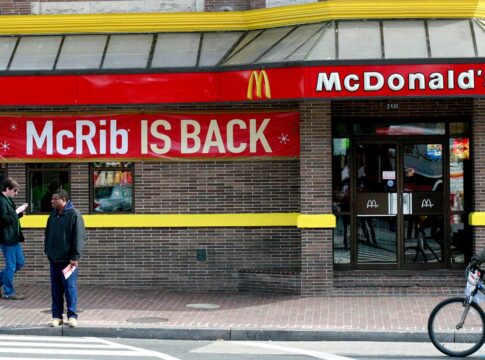
A federal judge in Chicago has rejected McDonald’s attempt to dismiss a class action lawsuit alleging the fast-food chain misleads customers about the meat content in its iconic McRib sandwich, allowing fraud and consumer deception claims to move forward.
Court Rejects McDonald’s Defense
U.S. District Judge April Perry ruled Friday that McDonald’s must face allegations that the McRib sandwich deceives consumers through its name and appearance. The judge allowed consumer deception, fraud, and unjust enrichment claims to proceed while dismissing five other claims without prejudice. Perry determined it was premature to conclude that reasonable consumers would not expect rib meat in a product marketed as the McRib.
The lawsuit, filed by four consumers last December, centers on whether McDonald’s deliberately shaped the pork patty to resemble a rack of ribs despite containing no actual rib meat. The plaintiffs presented consumer surveys showing 72 percent of respondents expected the sandwich to contain rib meat, while 67 percent considered rib meat an important factor in their purchasing decision.


What’s Actually in the McRib
The plaintiffs allege the McRib contains lower-grade pork products, including pork shoulder, heart, tripe, and stomach rather than rib meat. McDonald’s has firmly denied these allegations, stating the sandwich contains 100 percent pork sourced from American farmers and suppliers. The company explicitly told FOX Business it does not use heart, tripe, or scalded stomach in the McRib patty.
McDonald’s argued its publicly available ingredient list clearly identifies pork as the primary ingredient and that reasonable consumers would not be misled by the sandwich’s trademarked name. However, Judge Perry rejected the trademark defense, noting that other McDonald’s products like the McChicken and Egg McMuffin have names that accurately describe their ingredients, undermining the company’s argument.
Implications for Corporate Accountability
This ruling represents a significant moment for consumer protection advocates who argue corporations must be held accountable for accurate product marketing. The decision does not establish that McDonald’s engaged in deceptive advertising, but it allows the case to proceed to discovery, where internal company documents and marketing strategies will face scrutiny.
First introduced in 1981, the McRib has cultivated a devoted following through its periodic limited-time appearances at McDonald’s nearly 14,000 American locations. The boneless pork patty sandwich, covered in barbecue sauce and topped with onions and pickles, has become a cultural phenomenon despite its mysterious ingredients. As this lawsuit progresses, it may force greater transparency in how major corporations market their products to American families.